
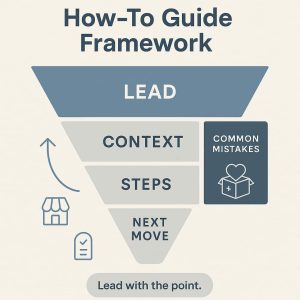
 Most how-to guides fall apart because they wander. They start too broad, add too many side notes, or bury the key points. News writing avoids that by answering the questions fast, staying tight, and keeping one main thread from top to bottom. Reporters write with urgency, clarity, and focus, which is why it works. That same structure works well for small businesses and charity guides, especially when the goal is to deliver small business information in a way readers can act on immediately. Keep it short, answer the big questions early, and stay disciplined, that’s the formula.
You don’t need to write like a journalist. You need to borrow the logic behind a good news story: lead with what matters, add context in layers, and keep the flow tight. Here’s how to do it.
Start with the lead: the most critical point.
It tells the reader the core of the story without making them dig for it.
Your guide needs the same thing. A reader should understand the point of your guide early, ideally by the end of the first paragraph.
For example:
Instead of:
“Small businesses often face challenges when trying to grow, especially with marketing and customer retention…”
Try:
“Growth stalls when small businesses don’t track where customers come from. Here’s how to fix that.”
It’s direct. It names the problem. It promises the solution. You’ve given the reader a reason to keep going.
Charity guides benefit from this even more. Donors, volunteers, and partners are busy. If they understand the main takeaway in seconds, they are far more likely to read on.
Follow with the “nut graph”: why it matters and who it’s for
Good news stories follow the lead with a paragraph that explains the significance of the topic and sets expectations for the story. In guides, this becomes your moment to frame the value.
This part answers questions like:
Who is this guide meant to help?
Why should they care?
What problem does it solve?
What can they expect to learn?
This helps readers decide whether to stay engaged and enables you to remain disciplined about the guide’s purpose. If you can’t explain why your guide matters in one tight paragraph, the guide probably needs sharper focus.
Use clear sections that follow the logic of questions a reader would ask.
News stories follow an order driven by reader curiosity: What happened? How did it happen? Who is affected? What comes next? Your guide should mirror that pattern.
Think about the questions a reader has when they click your guide, and answer them in a natural sequence. For example, a guide for a small business might flow like this:
What the problem looks like? Describe the situation clearly with plain language and examples.
Why does the problem happen? Offer simple explanations, not long theory.
What to do about it? Walk through the steps in order. Short steps. Clear instructions.
Common mistakes to avoid: Readers value knowing what not to do just as much as what to do.
How to measure success? Give them a way to know they are improving.
Charity guides follow the same pattern. A guide on improving volunteer retention, for example, would walk through what low retention looks like, why volunteers drift away, what actions help, and how to track progress.
This order keeps readers from guessing. It also keeps you from writing circles around your topic.
Keep paragraphs short and sentences clean.
News writing relies on rhythm. Short paragraphs, often only a few lines, help the reader move quickly. Short sentences help ideas land without effort.
You don’t need to write in bursts, but aim for clarity:
One idea per paragraph.
One clear point per sentence.
No long, winding explanations.
Minimal filler.
If you can say something in fewer words without losing meaning, do it. And avoid empty phrases reporters cut on sight: “in today’s world,” “it’s important to note,” “at the end of the day,” “now more than ever.” These dilute credibility rather than build it.
Use examples the way reporters use quotes.
Examples give a guide its human texture. They make instructions more straightforward and more believable. Think of them like quotes in a news story: short, specific, and tied to something real.
For instance:
“After the local bakery started sending a thank-you text the morning after each order, repeat purchases jumped within a month.”
Or for a charity:
“A volunteer who once checked in only once a quarter began showing up weekly after the coordinator started sending short updates about program impact.”
The examples don’t need stats or drama. They need to show the idea in action.
Close with clarity, not a summary.
A news story doesn’t end by repeating the lead. It ends by leaving the reader with something final: context, a next step, or a sense of direction. Your guide should do the same.
Close with a simple point. Focus on what the reader should do next or keep in mind as they apply what they have learned. Make it practical, not poetic.
Something like:
“You don’t need to overhaul everything at once. Start with one or two steps, track what changes, and adjust as you go.”
A clean finish shows respect for the reader’s time.
Good guides don’t need dramatic writing or complicated structure. If you build them like a news story with a clear lead, focused framing, logical order, real examples, and a purposeful ending, you make them easier to read and far more helpful. And usefulness is what earns trust, whether you are helping a small business owner or a charity team trying to do more good with limited time.

